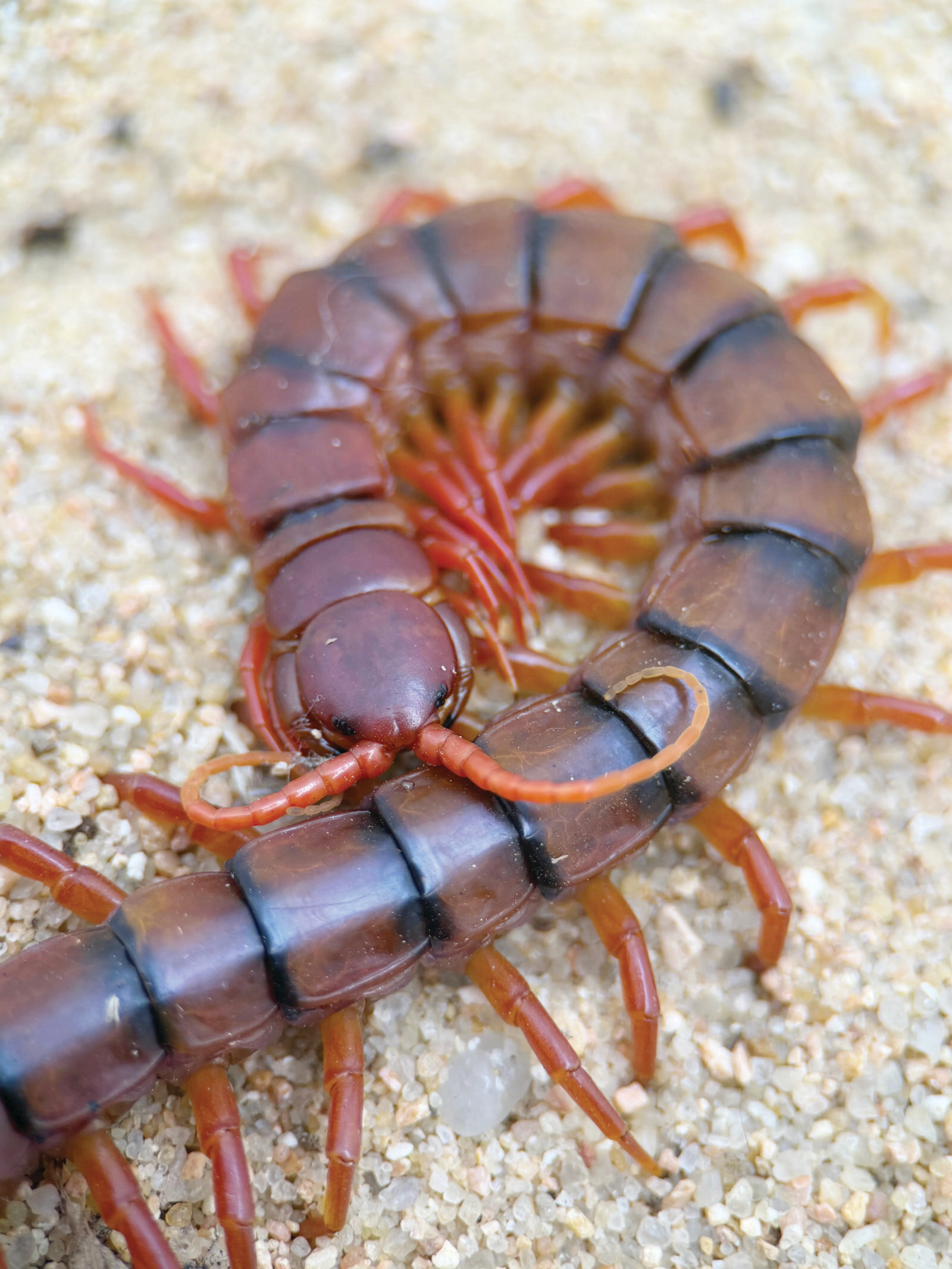
By the time the dinosaurs appeared, centipedes had already been around for hundreds of millions of years.
The dinosaurs are no more, but centipedes are. That creepy little predator under your garden leaf litter has a remarkable evolutionary story to tell.
Few creatures inspire quite the same mixture of fascination and apprehension as the centipede. Fast-moving, many-legged and armed with a rather formidable pair of venomous pincers, they are not everyone's favourite garden visitors.


Yet these remarkable animals deserve our respect – and not because of their somewhat alarming appearance. They are among the great survivors of evolutionary history.
Centipedes belong to a group of arthropods called Chilopoda. They are not insects, but belong to an ancient lineage that also includes millipedes. Their characteristic feature is a flattened body with one pair of legs on each body segment. (Millipedes have rounded bodies and two pairs of legs on most of their segments.)
The centipede’s first pair of legs has evolved into specialised venom-delivering appendages, called ‘forcipules’, which they use to capture and subdue their prey.
They certainly are old. Fossil evidence places recognisable centipedes at some 418 million years ago, during the Silurian Period. To put that into perspective, dinosaurs did not appear until roughly 230 million years ago. Centipedes had already been hunting on land for nearly 200 million years before the first dinosaur walked the Earth.
But what did they hunt, and what did the world look like when they first appeared?
Four hundred million years ago, the landscape was dominated by low-growing, primitive vegetation. Early plants such as Cooksonia consisted of tiny, branching green stems, often only a few centimetres high. They grew in damp places along streams and lakes, gradually establishing themselves on what had been largely barren land.
A terrestrial food web was already developing. Fungi and microorganisms were breaking down organic material, while tiny arthropods, including mites, springtails and other primitive relatives of modern insects, were beginning to exploit this new environment. These small creatures provided food for predators such as centipedes.
In other words, centipedes were among the pioneering predators of life on land. They were part of the very early community that helped shape terrestrial ecosystems as we know them now.
The first forests developed considerably later, during the Devonian Period, around 390 million years ago. By then, the diversity of terrestrial plants and animals was increasing rapidly. Trees provided new habitats, leaf litter created richer soils, and increasingly complex food webs developed. Centipedes – already well established – would continue to thrive in these changing environments.
Their success is perhaps best explained by their remarkable specialisation. They are efficient predators, generally nocturnal, and spend their days in cool, damp hiding places beneath stones, logs and leaf litter. Their diet includes insects, spiders, worms and other small invertebrates.
This makes them useful allies for gardeners. They help regulate populations of other invertebrates and are an important part of a healthy soil ecosystem. Although a bite from a large centipede can be extremely painful, they are not toxic. They are not aggressive towards humans and will generally bite only when handled or threatened.
Creepy or not, they are nevertheless living representatives of one of the oldest successful lineages of predators on Earth. That has to count in their favour.
Enjoyed this story? Get the whole paper first
The top stories and the whole edition, in your inbox the moment the new paper is out.