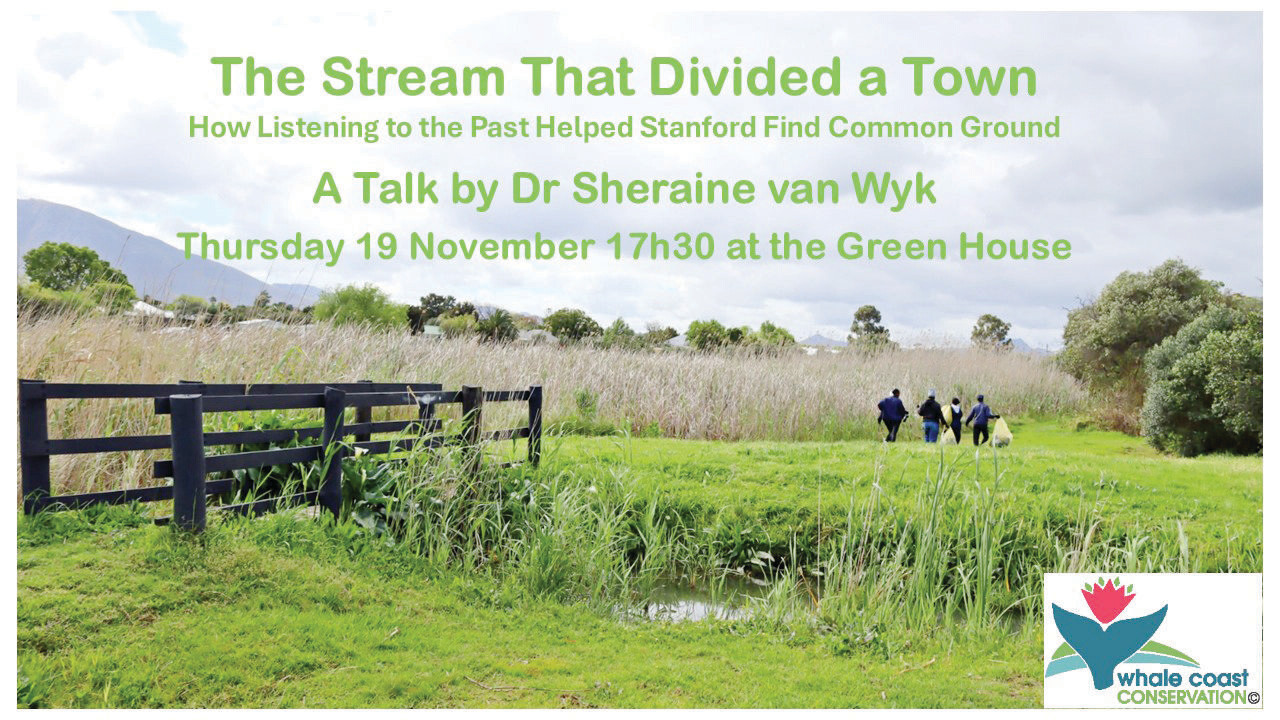
The Mill Stream in Stanford may look like an ordinary river, but it bears the scars of the town’s apartheid past.
Families classified as Coloured were forcibly relocated to its southern side, while a sand-mining pit, left behind in the stream, once claimed the life of a child.
Today, free irrigation water still reaches the northern side but not the southern. Die Bron Primary School, next to the wastewater treatment works, suffers disruptions to teaching and learning, yet has no access to grey water to irrigate its grounds. Unable to afford alternatives, the school’s sports development also suffers.


For years, efforts to rehabilitate the stream stalled – not because scientific answers were lacking, but because community groups had competing priorities.
Some wanted the borrow pit removed and safe swimming restored; others prioritised job creation, bird habitat or comprehensive ecological rehabilitation. Each position was legitimate, but the competing interests left the ward committee unable to reach consensus, allowing the status quo to persist.
The breakthrough came when the community realised the solution didn't begin with a technical intervention. Instead, a research team spent a year bringing the town’s ward committee together through facilitated discussions. They openly acknowledged Stanford’s history and walked the length of the stream together – an experience many had never shared. Crucially, they listened to one another before devising a plan.
Then, old photographs dating back to 1938 revealed that the stream had once featured clean, shallow, swimming pools. This provided a shared vision of restoring the stream to something of its former glory, helping bridge the divide between safe swimming and bird conservation.
The outcome was a community-authored plan, unanimously adopted and subsequently incorporated into the municipality’s official planning. It has since attracted funding for youth training, outdoor education and wetland conservation.
The borrow pit remains, remediation hampered by funding constraints and bureaucratic delays. Yet the most enduring achievement has been a change in the community’s relationship with the stream: a growing sense of shared responsibility, concern and stewardship for the waterway and its surrounding natural environment.
The Mill Stream dispute will be the topic of a discussion presented by Environmental Awareness and Education Manager at Whale Coast Conservation (WCC), Dr Sheraine van Wyk, on 19 November at The Greenhouse at 17:30.

Enjoyed this story? Get the whole paper first
The top stories and the whole edition, in your inbox the moment the new paper is out.