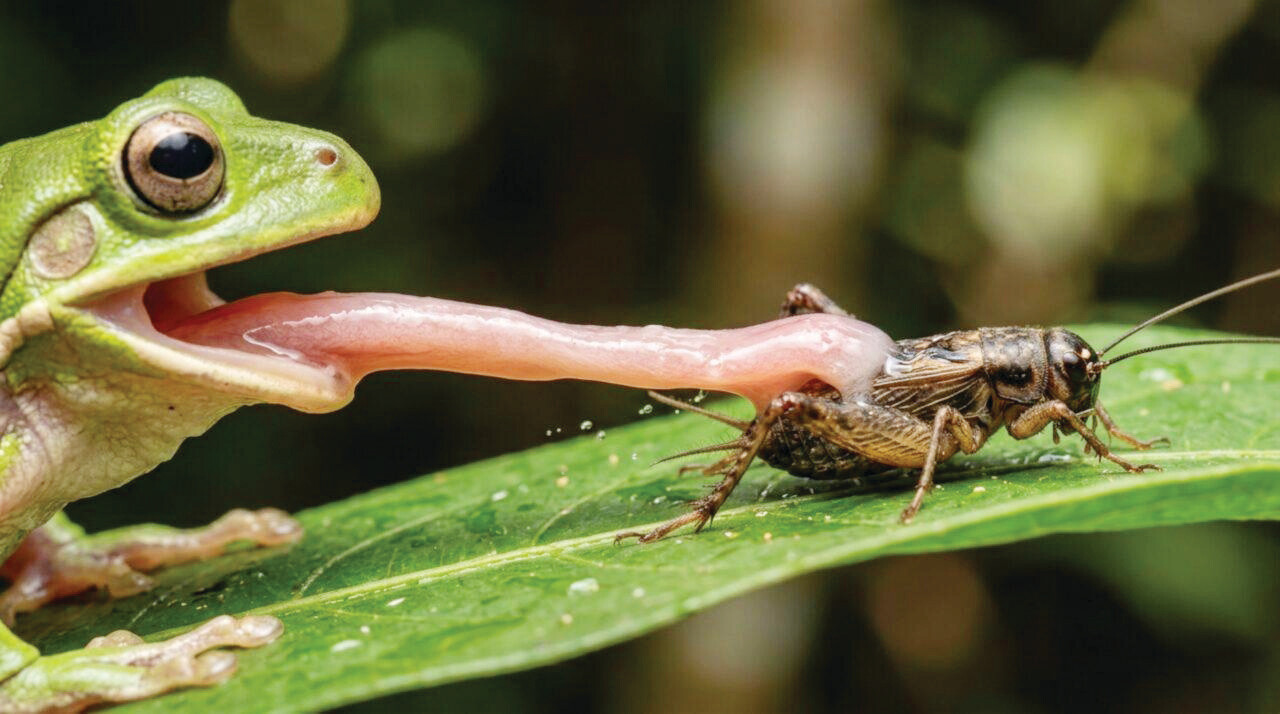
The amazing what, you may ask. Anurans are a group of amphibians that includes frogs and toads. Many of them use a specialised tongue to catch insects and other small animals, sometimes in less than a tenth of a second.
But the tongue’s remarkable speed is only part of the story. Its softness, elasticity and unusual saliva make it an exceptionally effective reusable biological adhesive. In fact, the humble frog’s feeding mechanism has served it well for millions of years without needing evolutionary tweaks.
Unlike the human tongue, which is anchored at the back of the mouth, a typical frog’s tongue is attached near the front of the lower jaw. Its free end points backwards when resting inside the mouth.
When prey comes within range, the frog opens its mouth and projects its tongue forwards very rapidly. The tongue contacts the insect, adheres to it, and retracts, taking the prey back into the mouth. Some frogs can extend their tongues remarkably far relative to their body size.
High-speed video has revealed that the tongue is remarkably soft and flexible. Rather than striking the insect as would a rigid dart, it deforms around the prey, increasing contact area and cushioning the impact. This helps prevent the insect from ricocheting off the tongue and keeps it intact.
Scientists investigated the tongues and saliva of several frog and toad species. They found that the tongue combines exceptionally soft tissue with saliva that behaves in a rather unusual way.
The saliva is a so-called non-Newtonian fluid. This means its viscosity changes according to the forces acting on it. When the tongue strikes an insect, the saliva becomes less viscous and spreads easily over the prey, helping the tongue to make good contact. As it pulls back, the saliva thickens and becomes more resistant to flow, gripping the insect firmly.
During swallowing, the saliva flows more readily again, allowing the prey to be detached easily from the tongue. The result is an ingenious, reversible adhesive — one that can grab a moving insect, hold it securely, and then release it at the right moment.
Catching prey and releasing it into the mouth is only half the challenge. The frog must now get the food down its throat and, surprisingly, here its eyes help.
Unlike humans, frogs generally swallow their prey whole rather than chew it. Also, unlike humans, most anurans can retract their eyes into their heads. During swallowing, the eyeballs and associated muscles move down into the roof of the mouth, where they help push the prey towards the oesophagus.
How does the anuran tongue differ from that of the chameleon? For starters, chameleons are not anurans, but like frogs, their tongues play a vital role in feeding.
Frogs’ and chameleons’ tongues are features of two groups of animals that have evolved different solutions to the same problem of catching prey in a fraction of a second. The key difference is how they generate the launching force.
The chameleon has a more specialised launching system. Its tongue rests over an elongated supporting structure called the entoglossal process, part of the hyoid apparatus.
Specialised muscles and elastic connective tissues surround this structure. Before the tongue shoots out, the accelerator muscles contract and load the system with energy – like an archer pulling a bowstring. The stored energy is then released rapidly, launching the tongue, tipped with a specialised pad, towards the prey. The tongue is projected up to 2.5 times the body length.
This is a form of elastic power amplification: the muscles can build up energy over a longer period and release it far faster than they could through direct contraction alone. The tongue tip has a specialised pad that can adapt its shape to the prey. Thick, viscous mucus on the pad helps form a strong adhesive connection, even when the prey is relatively large.
Once captured, the prey that is transferred to the mouth is processed. Like frogs, chameleons swallow their prey whole.
Enjoyed this story? Get the whole paper first
The top stories and the whole edition, in your inbox the moment the new paper is out.