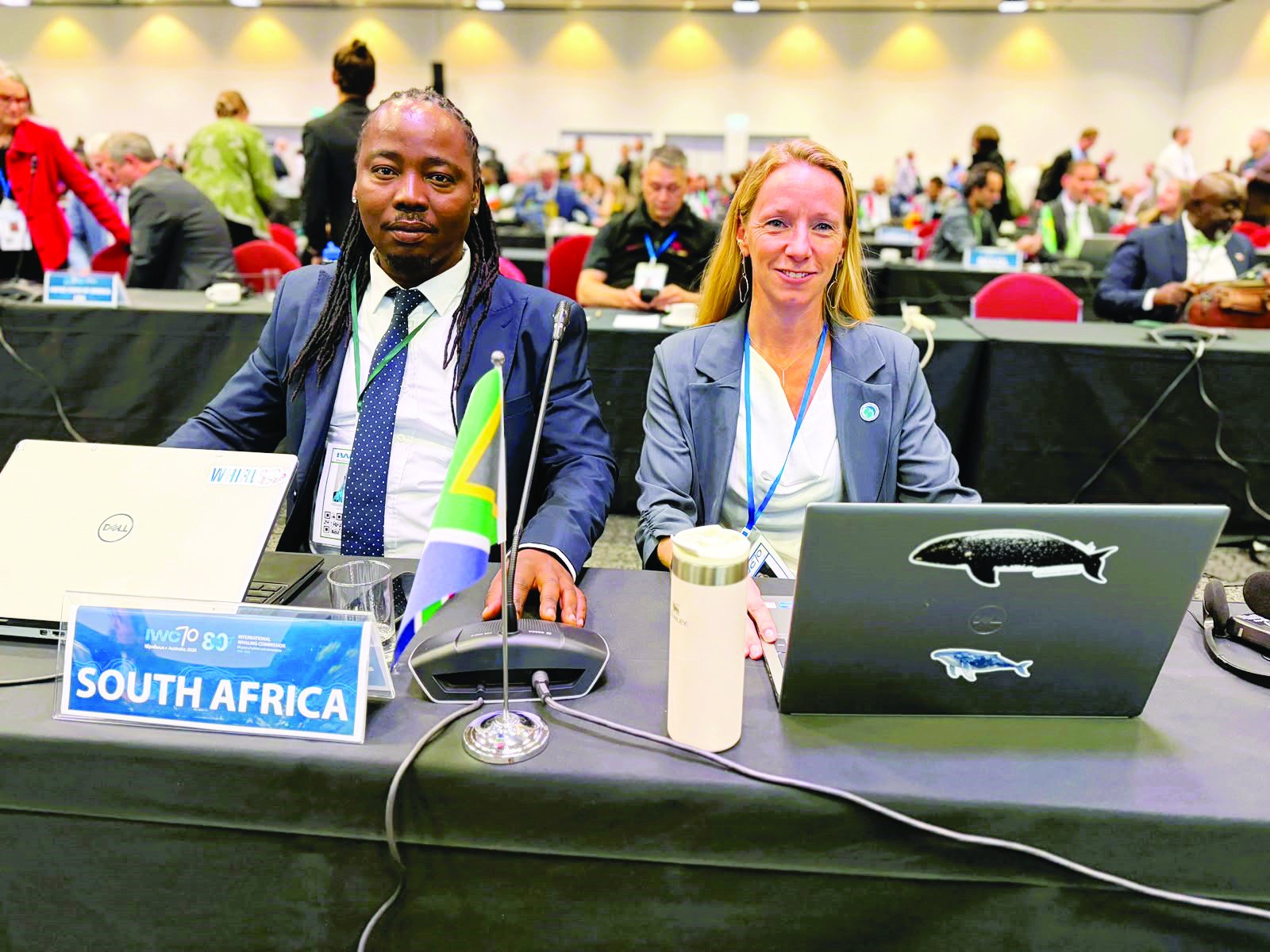
Hermanus-based whale researcher Prof Els Vermeulen has been elected to the International Whaling Commission’s (IWC) three-person leadership team, becoming the first South African to hold the prestigious position.
Vermeulen, head of the University of Pretoria’s Mammal Research Institute Whale Unit, was elected for a six-year term at the IWC’s 80th anniversary meeting in Hobart, Australia, this week. Her appointment marks a significant new chapter in a decade of service on the commission’s high-level Scientific Committee.
She will serve the first two years as vice-chair-elect, followed by two years as vice-chair and a final two years as chairperson.

From the outset, the IWC recognised that science must underpin its work to regulate the management and conservation of whales. The IWC Scientific Committee is a long-standing, highly respected group of about 200 world-leading experts in a range of topics related to cetacean science, conservation and management.
Marine biologist Prof Peter Best, described as the world's foremost authority on the whales and dolphins of the southern African region, was elected as vice-chairman in 1982. Despite being in line to become chair, he was unable to step into the role because South Africa ceased its national whale research programme. He subsequently established the whale unit at the University of Pretoria in 1985 and brought, with him, one of the world’s longest continuous and most extensive data sets on whales and dolphins.
When the IWC was formed in 1946, global whale and dolphin populations were in dire straits, due to widespread and uncontrolled whaling. Following a moratorium on this practice in 1986, the revival of most species has been spectacular, with only Iceland, Norway and Japan still conducting commercial whaling. Today, only two whale and three dolphin species remain critically endangered – the Vaquita in Mexican waters comprises only 50-odd individuals.
Bycatch, especially involving dolphins, and vessel strikes remain the primary human-induced causes of death, but global warming is increasingly the subject of intense scientific research. However, as Vermeulen stresses, given the situation’s complexity, it is unlikely that a one-size-fits-all solution will be found.
With the conclusion of the whale unit’s recently conducted aerial whale count, she reports that the cyclical pattern of the last decade has been maintained. With 222 pairs of southern right cows and calves counted, as well as 25 single adults, numbers are expected to increase next year. However, with a super-strong El Niño on the way, the outcome could be negatively affected.
Vermeulen is deeply committed to the whales. Since the whale unit was established, it has grown from strength to strength under her direction, making a significant contribution to scientific knowledge pertaining to these fascinating creatures and ensuring their continued survival. As a member of the leadership team at the IWC, her influence will undoubtedly take on greater global significance.

Enjoyed this story? Get the whole paper first
The top stories and the whole edition, in your inbox the moment the new paper is out.
More news from Hermanus