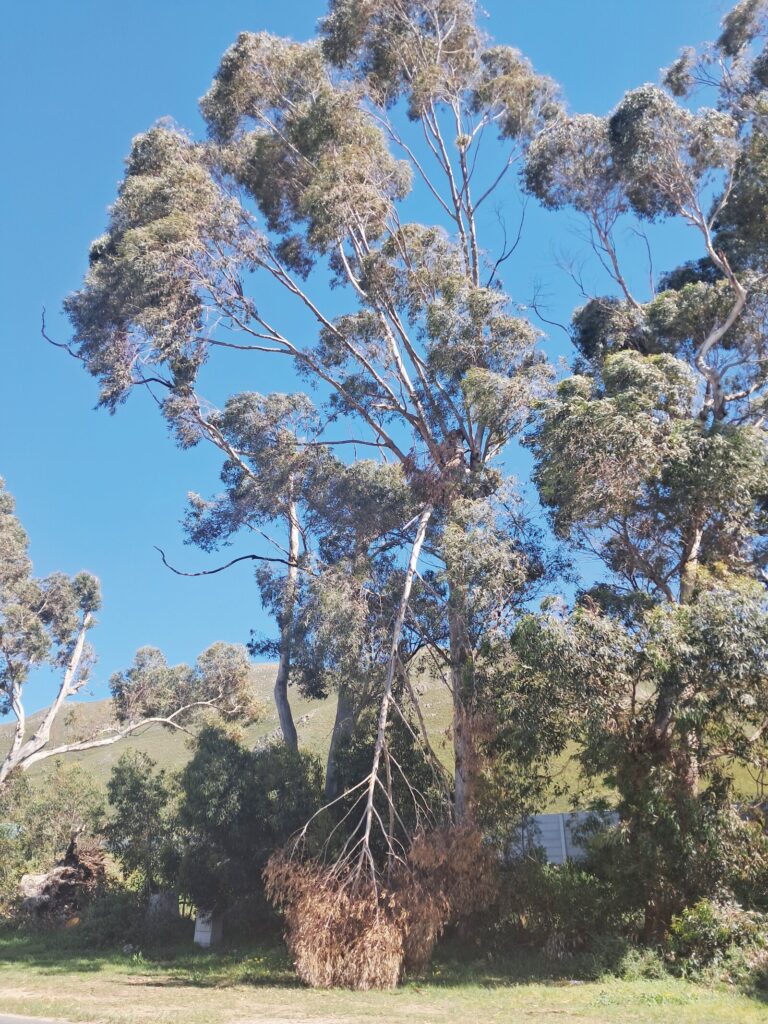
The tall gum trees lining Jose Burman Drive are becoming a cause for concern. Tall, straggly and prone to losing branches, they could pose a danger when the next strong winds arrive.
Motorists and their vehicles are potentially at risk, but of greater concern is the proximity of Hermanus High School. Falling branches could have devastating consequences for children, staff, and parents using the school drop-off and pick-up area.
It is encouraging to see that the school’s management has already had the tree at its back entrance cut back. But what about the remaining trees along the road?
There is another issue worth considering. Although gum trees create an attractive, leafy avenue, they are also notorious water guzzlers. At a time when water conservation should be a priority, is maintaining thirsty trees such as these the best use of this precious resource?
Perhaps the municipality could assess the condition of these trees and consider a long-term solution – including replacing those that pose a danger with suitable, less water-intensive indigenous trees.
We all appreciate the beauty and shade trees bring to our streets. But when public safety and water security are at stake, surely prevention is better than waiting for a disaster.
I have submitted a formal request to the Overstrand Municipality under the Promotion of Access to Information Act (PAIA) for records relating to complaints arising from the Ward 7 committee meeting of 12 February this year.
These complaints, including mine of 13 February and a follow‑up on 27 May, concern the conduct of Cllrs Lombard and Gillion, and others, who, in my view, unlawfully prevented attendees from recording the meeting and had people forcefully removed.
I have requested records relating to the investigation and handling of these complaints, including the appointment and membership of the panel of councillors reportedly established to investigate them, witness statements, interviews, investigation reports, findings, recommendations and correspondence with Western Cape Local Government MEC Anton Bredell and his department.
There is a particular reason for seeking these records now.
In an email dated 17 February, the then Overstrand municipal manager, Dr Dean O’Neill, stated that the matter had already been referred to MEC Bredell. In another email on 16 April, he confirmed that an allegation of misconduct against Cllr Lombard had been tabled before Council and that the Speaker had appointed a panel of councillors to investigate and recommend appropriate action.
MEC Bredell informed me in an email on 6 August that he referred the matter to O'Neill and Cohen. It was clear from this email that MEC Bredell has not received any referrals or reports from either O’Neill or Cohen.
Neither Cohen nor Mayor Archie Klaas bothered to reply to any of my emails, and there has been no public clarity about what was investigated, by whom, what was found, and what action, if any, followed.
I have therefore asked the municipality to provide the relevant records, and I have received the reference number of my PAIA application.
The request was submitted on 2 October. Under Section 25(1) of PAIA, the municipality has 30 days to notify me of its decision. The statutory deadline is therefore 2 November 2026.
If the municipality refuses access to any records, I expect it to identify the specific legal grounds for doing so. If it claims an extension, I expect proper reasons.
After months of unanswered questions, the public deserves transparency about what happened at Ward 7 and what, if anything, was done about the complaints.
There was great excitement in August when Ariane Groenewalt, a Grade 6 pupil at Laerskool Kleinmond, earned a place in the Western Cape primary schools’ team to compete in the South African Equestrian Schools Association (SANESA) national championships in Johannesburg during the recent September long weekend.
Hundreds of experienced competitors from different provinces were participating in 16 disciplines, so what were her chances?
Ariane had been taking lessons at the Klein Paradys Equestrian Centre in Bot River for less than two years, and Texan, her faithful riding-school horse, was 25 years old and had never participated in an event this big.
With many of the horses competing against them highly bred aristocrats, valued at R1 million or more, Ariane’s participation was, primarily, to gain experience for future competitions.
But Arianne and Texan refused to back down, as the record shows:
Show-jumping: Gold medal
Show-jumping 2nd phase: Gold medal
Dressage Test 1: Silver medal
Equitation: Silver medal
Dressage Test 2: 5th place
Working rider: 10th place (with a percentage of 95%)
There’s no stopping Overstrand modern pentathlon ace Daniel Grové’s appetite for gold.
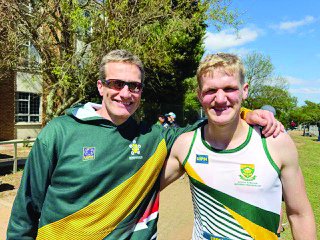
The 17-year-old Junior Protea of the Hemel-en-Aarde Valley successfully defended his African Continental Laser Run title in Cape Town on Saturday, adding another major achievement to an extraordinary 2026 season.
The victory came after a demanding race in strong winds, which made the shooting sections particularly challenging. Laser Run combines running and laser-pistol-shooting in alternating stages.
“The wind was very strong, especially with the shooting – it threw me off target. But I was able to recover with the running,” Daniel said.
His ability to compensate for the shooting-range difficulties with his running proved decisive. Training on his family farm, often in the Western Cape’s notoriously unpredictable weather, has helped prepare him for such conditions.
Daniel also displayed impressive tactical maturity. South African rival Dylan Kruger provided strong early in the competition, with the pair running together during the opening stages.
“I wanted to stick with Dylan for the first lap to get warmed up and get my focus right,” Daniel explained. “And then I went for it with the shooting.”
The strategy paid off as Daniel found his rhythm, pulled away from the field and secured his second consecutive continental title.
The victory caps a remarkable season in which Daniel has competed on the international stage in Cairo, Budapest and Madrid. His 2026 highlights include a silver medal in the U19 World Championships in Madrid, the U19 SA Modern Pentathlon title, and a sixth-fastest Laser Run time at the UIPM World Cup Final in Budapest.
He is currently ranked fifth in the UIPM U19 world rankings and 17th among juniors.
For now, however, another challenge takes priority. The homeschooled Cambridge student has put competition on hold for two weeks to concentrate on his examinations.
The independent Waldorf School Hermanus in Sandbaai – mainly for primary school pupils from Zwelihle and Mount Pleasant – celebrated its 30th anniversary in 2024.
That was the year it took a pioneering step into the future by adding Grade 8 to offer matric vocational training because too many former learners, who had achieved good academic matric results, were unable to find meaningful jobs.
Reaching this decision – with serious cost implications – took more than two years of negotiations before the Department of Higher Education agreed to register the proposed vocational high school.
Registration was confirmed in August this year, but the school had already enrolled 15 Grade 10 learners to start the first phase of the three-year vocational training curriculum in January
As a non-profit institution, where many learners’ school fees are subsidised, the additional expenditure was a tough ask. Waldorf’s main sponsors in Germany, however, agreed to help with building costs and equipping the requisite workshops.
Although the college was registered to offer three skills training courses, its board decided to start with two this year – Primary Health Care and Electrical Infrastructure and Construction.
The three-year curriculum includes fundamentals such as languages, life orientation and standard maths, combined with computer technology. Other subjects are added, as applicable to the specific training stream concerned.
Although not part of the formal curriculum, Waldorf will offer entrepreneurship training. Internships with relevant business undertakings also form part of the course structure.
For more information about the project or to offer opportunities for internships, send an to email adminhead@hermanuswaldorf.co.za
For the past three years, 14 dedicated Botrivier residents and associates have been working to bring quality skills education to the village and give young people an alternative to the traditional academic high-school route.
Overberg Our Community Our Future (OOCOF) is working towards establishing the Botrivier School of Skills, an independent, low-fee school for 240 learners over four years of training.
Land has been identified below the proposed Theewaterskloof (TWK) housing development. Before construction can begin, part of the property must be rezoned for educational use and undergo an environmental assessment.
OOCOF is receiving support from the Jakes Gerwel Education Trust in Bonnievale to help lay the groundwork and accelerate the project.
In the meantime, an interim training programme has been launched from a workshop behind Astra Garage. The 12-week programme is for young adults aged 17 to 24 years who are no longer at school and want to explore a future based on practical skills.
Each training cycle accommodates 10 trainees. Initially focussed on workman’s assistant training, it introduces practical, workplace skills and encourages participants to pursue further skills-based education.
Local trainers Frik Jacobs and Andie Coetzee facilitate the programme. Jacobs has extensive experience as a skills trainer in Richards Bay, while Coetzee brings experience from the education department’s district office.
Successful participants will receive a ‘Testament of Attendance' certificate outlining the areas of learning and aptitude they demonstrated. While the document is not an official qualification, OOCOF says it reflects the training programme's seriousness and integrity.
OOCOF hopes the interim programme will help build momentum towards establishing the full school and create new opportunities for young people in Botrivier.
For information about the training programme, phone Manie Carelse at 082 420 4343 or email oocof@outlook.com. Donations can be directed to Ebrahim Khan at 083 259 7425.
Investors are never more than a few taps away from the market. Real-time price movements, breaking news alerts and an endless stream of commentary from economists, journalists and investment professionals are all a swipe away.
More information should mean better decisions. That's the theory, anyway. In practice, many investors feel more anxious and less certain than ever.
The reason is simple: access to more information doesn't automatically make you a better investor. It often just makes you more aware of things you don't need to react to.
Investing has never been more accessible, transparent or convenient. With a few taps on a smartphone, you can monitor your portfolio, track every market movement, and access financial news and commentary at any hour. That's a real advantage. But it has also made it harder to look past the short-term volatility that comes with long-term wealth creation.
Markets are always digesting something. Interest rates shift, elections happen, growth speeds up or slows down, companies beat or miss expectations. These events move prices daily — but most of them have very little bearing on your long-term plan. The challenge is exposure: when every development reaches you in real time, it can start to feel important, even when it isn't.
A pot of water never boils faster because you keep lifting the lid to check on it. Instead, you let the heat out and delay the outcome you're waiting for.
Investors can fall into the same trap. Monitor the portfolio often enough, react to enough headlines, and you can undermine a strategy that only needed time to work.
Financial media doesn't make this easier. Outlets compete for attention in a crowded space, and a dramatic headline will usually outperform a measured one. That means a steady stream of predictions about crashes, crises and opportunities that supposedly require immediate action. Some of it may be worth reading. Very little of it justifies changing a carefully built, long-term strategy.
This creates a kind of paradox. Watching daily market trends closely only heightens the temptation to act. In both cases, emotion starts to influence decisions – delaying an investment while waiting for a better entry point, chasing recent top performers, or abandoning a sound strategy at exactly the wrong moment.
Warren Buffett put it well: the stock market is "a device for transferring money from the impatient to the patient". It's a simple observation, but it captures something important. Long-term wealth isn't usually built by reacting to every development or trying to outsmart the market. Instead, wealth comes from staying invested, remaining disciplined, and giving time and compounding room to work.
History shows this repeatedly. Markets recover from periods of uncertainty, economic weakness and geopolitical tension. What tends to cause the most damage isn't the volatility itself – it's investors abandoning their plans because the volatility became uncomfortable.
Successful investing therefore takes patience and restraint. You can't control market returns, inflation, interest rates or political events. You can control how much you save, how consistently you invest, and how you respond when markets turn turbulent. Those factors tend to shape long-term outcomes more than any single piece of breaking news.
None of this means ignoring the market altogether. Staying informed still matters. What matters more is recognising the difference between information that improves decision-making and information that's mostly noise. Not every market movement calls for a response. Not every headline calls for a portfolio adjustment.
In investing, knowing what to ignore is a superpower. Long-term wealth is rarely built through constant action. More often, it's the result of a disciplined plan, sensible diversification and the patience to stay the course when short-term events make that difficult.
Next time a market alert appears on your phone, ask a simple question: does this genuinely change my long-term financial objectives?
In most cases, the answer will be no.
Sometimes the greatest investment advantage comes not from knowing more, but from knowing what to ignore.
Note: The opinions expressed in this document are the opinions of the writer and not necessarily those of PSG and do not constitute advice. Although the utmost care has been taken in the research and preparation of this document, no responsibility can be taken for actions taken on information in this article. Always remember the prudent way is to consult your portfolio manager before investing.
It came as no surprise to me to read in the media that out of 375 libraries, Hermanus Library again won the trophy for Public Library of the Year in the Western Cape, as well as the Best Friends of a Public Library award and runner-up in the Digital Literary Champion category.
Hawston Library also excelled, adding to its historic accolades the Community Impact Through Outreach award and runner-up in the Reading and Literacy Champion category.
I have witnessed firsthand the invaluable, professional and friendly service the Hermanus Library staff have provided. I have noted their organisational expertise in the Onrus Manor library, and I am aware of their sterling work at many other retirement villages and old-age homes in the area.
The staff of our local libraries deserve our heartfelt appreciation for undertaking their roles with such dedication. The impact reaches deep into our communities, and its value is profoundly and positively felt.
Rotary Club Hermanus recently hosted a thought-provoking presentation titled Building bridges between Hermanus’ formal and township economies.
The speaker, marketing guru GG Alcock, has published three books on the subject, the most recent being KasiNomics Unleashed. The morning’s formal presentation was followed by a lively interactive discussion with Alcock that afternoon.
Participants included a cross-section of Hermanus businesspeople from the formal sector, NGOs operating at grass-roots level, local government and township youth.
Alcock challenged the traditional description of township business as merely informal, underdeveloped or survivalist. He presented it as a large, diverse and highly active economy, driven by entrepreneurs who understand their markets and respond quickly to changing needs.
He painted a picture of ‘kasipreneurs’ with out-of-the-box thinking, who see business development as a journey rather than an end. They identify opportunities in their own communities and find creative ways to fill them.
Although most of our townships and informal settlements are characterised by severe poverty, there’s a growing middle class that aspires to high-quality household furnishings and equipment, owns vehicles and digital devices, and is interested in personal beauty.
In Alcock’s opinion, beauty salons, informal car repair and panel-beating workshops, taverns and eateries specialising in kasi-kos (more profitable than spaza shops), as well as home rentals and efficient transport services are among the fastest-growing sectors in the township economy.
In various parts of the country, formal and informal business sectors, at corporate and local levels, have formed mutually profitable partnerships. For such an arrangement to succeed, however, Alcock emphasised, it should be based on a clearly identified community need, rather than being externally imposed.
The Overstrand is firmly gripped in property-boom fever.
We are no longer aspiring to join the ranks of South Africa’s so-called ‘Millionaires’ Row’. Judging by the astronomical prices fetched in Hermanus over the past year – and increasingly in places such as Onrus – we have arrived. ‘Billionaires’ Row' might be a more appropriate description.
Estate agents, developers and property owners can hardly be blamed for enjoying the good times. But amid all the talk of record prices and lucrative returns, one wonders whether the noise of mammon is drowning out a more uncomfortable question: What is this property boom doing to the society that already lives here?
The environmental consequences are obvious. Ever more intensive development, in an area blessed with extraordinary conservation value, risks eroding the natural heritage that makes the Overstrand desirable in the first place. Destroy the goose that lays the golden eggs, and the property boom may consume its own foundations.
But there is another, less-discussed casualty – ordinary residents, especially the retired sector.
Increasingly, one hears murmurings from elderly residents who came to the Overstrand years ago, built their lives here and carefully planned their retirement around the homes they own. Now, soaring property values can translate into sharply higher municipal rates. Their financial planning may have been sound, but the arrival of substantially wealthier neighbours can make staying in their own homes increasingly difficult.
It is a new twist on the old saying: There goes the neighbourhood.
The four-yearly municipal valuation process is based on, among other things, property values and comparable sales. As sale prices soar, so can the assessed value of surrounding properties – and with it the rates burden.
For some, the eventual choice may be stark: find the money to keep up or sell the home they regarded as their piece of paradise.
The younger generation faces an equally vicious circle. As property prices rise, so do rentals, making it increasingly difficult for people who work in the Overstrand – teachers, nurses, municipal workers, hospitality staff, tradespeople and others – to find affordable accommodation anywhere near their jobs.
A place can become wealthy while becoming progressively less affordable for the people who make it function.
I am no property economist, but surely this deserves a more serious public debate than simply celebrating the next record sale.
As a former mayor once put it: “You can’t stop development.”
Perhaps not. But must we surrender to every consequence of market forces?
Can development be managed in a way that protects the environment while ensuring ordinary residents, including those who helped build the Overstrand into what it is today, are not gradually priced out of their own communities?
The property boom may be creating fortunes. But we should also be asking what, and who, is being sacrificed along the way. It would be valuable to hear from people experiencing these pressures, and from property experts and municipal officials who can explain what can realistically be done about this issue – if anything.
NO-SHOW FESTIVAL
The controversy surrounding the Milkwood Festival continues.
It did not take place at the Zwelihle Sports Ground on Saturday. The Overstrand Municipality was informed that the event organiser withdrew his involvement from the festival application. Consequently, the municipality is now considering its right to recourse, which may include formal legal action.
And so the dance around this issue continues.
Surely it is now time to bring the matter to a close.
The public deserves to know what steps will be taken to hold those responsible accountable – and, crucially, what is being done to recover the R250 000 paid to the festival organisers from the mayor’s discretionary fund last year.
After all the promises, explanations and shifting arrangements, residents are now entitled to some clear answers.
Not a mailing list and not an algorithm. Real shelves, in real shops, from Grabouw to Kleinbaai — picked up by people
who live here, and still lying on the table on Sunday.
Every one of these takes a bundle each Thursday. 214 shops, cafés, filling stations and offices across the Overstrand. Tap any name to find it on Google.